


All over the internet, people are ditching digital. In place of tablet sleeves and phone charms, they’re gravitating towards analog bags. A trend sweeping TikTok and Instagram Reels, the Analog Bag trend has reached the Oat Foundry office. Honestly, we’ve always been analog inclined, as:
- Senior Production Technician Dan Fetters keeps a sketchbook and printed calendar close to X off his workout days
- Production Manager Chris Novak uses a fidget cube and has a label maker handy
- +1 to the fidget spinner for Multimedia Specialist Jah’meir Reed, who also has his copy of Reflections: On Cinematography by Roger Deakins close
- CEO Mark Kuhn uses green painters’ tape to organize his kitchen
- Sr. Mechanical Engineer & Co-Founder Jim Vescio keeps an all-in-one tool and flashlight in his car
- Sales Director Kristy Brunhofer carries stickers for her daughter
- Full Stack Developer Charles Hussey relies on physical books and puzzles to stay entertained
- Hardware Lead & Co-Founder Luc Tenthorey totes along juggling stuff
- Creative Director Sarah Van Bemmel has a notebook, pen, and wooden mechanical calendar on her desk
- Project Engineer Colin Lew is known for having a slide rule
- Digital Marketer Melissa Houghton carries Architectural Digest in her embroidered LL Bean tote bag and a Pilot 3-in-1 multifunctional pen
Whether it counts or not, Production Technician Lauren Hill’s pup Ruby could easily fit inside an analog bag.

Before we hop on the brand-making-a-trend-into-content bandwagon, here’s our reason for chiming in: the way we act in spaces inevitably influences spaces. The more people fit “analog” into their day-to-day lives, the more architectural firms and interior designers will follow suit, creating spaces designed around the ability to be “offline”.
So here’s what an Analog Bag actually is, and how the continued use of “analog” activities is set to redefine spaces in 2026 and beyond.
“A Look Inside Our Analog Bags” 📸 : Melissa Houghton
From Left to Right, Top: Sticker Sheet from Pipstickers, Red Notebook from Moleskine, Mt. Fuji 3-in-1 Mechanical Pen from Pilot, Bean Bags from Duncan Toys, Ruby from Lauren, Slide Rule from Keuffel and Esser, EDC Flashlight from Armes Bastille, Coil Puzzle from Art of Play, Painters’ Tape from Sherwin Williams, 3D Calendar from Robotime, and Fidget Spinner from Michaels.
What is an Analog Bag?
Exploring The “Going Analog” Trend
As simple as a repurposed tote bag, a proper “Analog Bag” is equipped with analog activities such as crossword puzzles, knitting and croquet supplies, and handheld journals. Designed to prevent “doomscrolling” or the overuse of phones, laptops, and tablets, the Analog Bag was born out of the urge to disconnect, a charge primarily led by Gen Z.
Jah-meir Reed, Oat Foundry’s Multimedia Specialist and unofficial “GenZ” rep for the office, has this to say about going “analog” in 2026.
“We (GenZ) love the offline life because most of us are tired of living/portraying our life on the internet,” he says. “For a while, the internet was a place where we could connect with friends. Now the internet is a whole bunch of noise, things trying to capture our attention. I know, as a multimedia specialist, this sounds a bit contradictory, but even I get tired of being on the internet.”
Fatigued with the constant demand to be online, Reed says he’s found “pockets of freedom” from creating on a blue screen or doom scrolling through analog photography on his Super 8.
“The Super 8 camera is completely void of all blue light tech,” says Reed. “Requiring only batteries and film capsules, Super 8 also has a unique look and feel, and the vibrancy that makes it distinctive and feel alive. A roll of film only gives you 2 – 3 minutes of footage, making every shot have intentionality and weight. No edits, no overshooting, just strictly vibes and living in the moment. Which I feel like in this age, many of us struggle to do.”

In the book “The Future Is Analog,” author David Sax argues for a digital-free future, critiquing a “digital utopia” and emphasizing the importance of physical spaces that foster offline connection.
📸 via Amazon
The Shift to Analog: Did it Start with AI?
Adopting an “analog” lifestyle is becoming so popular; in fact, brands are starting to return to the old brick-and-mortar aesthetic. From prioritizing tactile experiences to bringing back print materials, As the “internet” hive mind would say, “nature is healing”.
For some, the “always online” trend is about AI fatigue, with AI-generated content creeping into:
- Publishing, with outlets reporting that AI-generated books are flooding online publishers
- Customer service, with users complaining that AI Chatbots make it more challenging to get real-time support
- The legal system, with penalties “stacking up” for lawyers who use AI to create and file briefs
- Mental healthcare, with individuals turning to AI therapy chatbots over human therapists
But for most people, the desire to go “analog” isn’t only about escaping AI: it’s about trust. With the internet no longer a safe haven for “what counts as evidence, truth, and reality,” spaces and in-person experiences are filling a crucial gap.

The Guardian reports that analog devices and displays are on the rise, with more people switching to analog watches over digital.
📸 via Jainx

According to The New York Times and Business Insider, Analog alarm clocks are “completely changing” mornings.
📸 via Fallindesign

Brands are switching to analog displays such as split flaps and flip dots to add mechanical magic to spaces.
📸 via Think Create
How The “Analog” Lifestyle is Impacting Brand Spaces
Despite the call to arms for “all things analog,” most spaces need to strike a balance between the offline and online worlds — without unplugging completely. Here are the physical “third places”, setting serious boundaries around presence, while still leveraging the ease and convenience that digital can provide.

Forbes covered the “classic car drive-in” at Ofland Escalante, a boutique hotel in Escalante, Utah. A hotel from Yonder Hospitality and Roy Hospitality Design, the formerly “aged” RV park and drive-in theater was completely reimagined as a “refined rustic” experience.
📸 via Ofland Esalalante

The Siren Café is located within The Siren Hotel in downtown Detroit. Known for its “Wes Anderson” aesthetic, Vogue listed the hotel under its preferred travel experiences, including its “Candy Bar” cocktail bar and intimate lobby, an intentional design choice. Will Cooper of ASH NYC was the Creative Director of the project.
📸 via The Siren Hotel

Hotel Saint Cecilia, located in Austin, TX, features a “moody” lobby with a lack of screens. A fireplace is the feature focal point of the space, a design choice that allows hotel visitors to feel fully present in the space. The hotel was recently awarded a Michelin key.
📸 Hotel Saint Cecilia
Hotels and resorts
“Offline is the new luxury,” reports Amanda Hoover for Business Insider. In hospitality, this looks like luxury resorts offering:
- Offline amenities like DIY bonfire meal kits and even their own drive-in movie theater (Of Land Escalante, Utah)
- Access to record players and vintage vinyl in guest rooms (Hotel Saint Cecilia, Austin)
- Complimentary film photo printing (The Siren Hotel, Michigan)
- A selection of “mystery” books curated from The New York Public Library’s “Best Books” list (Andaz 5th Avenue, New York)

Imagine an elevator bay lobby designed to fit into the visitor experience, similar to The Ritz Carlton Philly. A strategically placed analog display can rotate through upcoming hotel events, weather updates, and dining options.

Hotels can introduce movement into otherwise static or screen-saturated spaces with a wall-sized flipbook. With images of hotel amenities, nearby attractions, and photographs that reflect the local culture, residential buildings such as Heritage Towers are already deploying this innovative custom installation.

Reception and concierge desks can skip the video walls and mounted monitors with a mechanical display programmed to share on-brand messages and custom guest greetings. Retailers like New York or Nowhere already use this analog signage to center their space.
As a brand that reimagines retro technology, we’ve created handcrafted mechanical Split Flap signs for hotels looking to migrate to more tactile, sensory design. The Ritz-Carlton in Philadelphia created a Split Flap to serve as luxury elevator bay signage, and both Union Station Hotel and Caption by Hyatt in Nashville invested in custom installations, including a dynamic bar menu board and an eclectic flipping “art board” made from Picture Flap. Even Carnival Cruise Line has gotten “on board” with a Split Flap display suspended over one of the ship’s bars.

Cooper Carry’s adaptive reuse of AT&T’s Dallas HQ reimagined a 2.5 million square foot space into a “food-anchored” experience. The Exchange, which opened in 2021, modernized the existing 1970s aesthetic as an industrial, artisanal space, dubbed “a culinary collective”.
📸 via Cooper Carry

The Tin Building, located in NYC, was a waterfront food hall inspired by the building’s original function: The Fulton Street Fish Market. The space closed in Winter 2026, originally developed with Howard Hughes Corporation and Vongerichten.
📸 via The Tin Building

St. Roch Market in New Orleans has a fresh, modern look. Kevin Pedeaux of CR Coffee took over the lease in 2023, after years of locals frequently expressing concerns regarding the affordability and gentrification of the historic space.
📸 St. Roch Market
Food Halls
The “food hall,” as we now know it, surged in popularity in the late 1800s through the 20th century, before falling out of “vogue” in 2015. Yale’s CitySCOPE podcast attributed the former food hall phenomenon to a “seven-year explosion” of “food truck, farmer’s market meets vendor market.”
Today, the food hall craze is back, with locations popping up all over the United States:
- Large cities such as Philly (Gather Food Hall on Market Street), San Francisco (Saluhall on Market Street), and NYC (Shaver Hall)
- Towns like Brentwood, MD (miXt Food Hall on Rhode Island Ave)
- Reimagined chain retail concepts like Wonder and Eataly

Imagine a food hall defined by presence. With analog displays in place of screens, spaces can recapture the magic of historic market movement. Momofuku Noodle Bar in NYC exemplifies sensory design with its mechanical Split Flap menu.
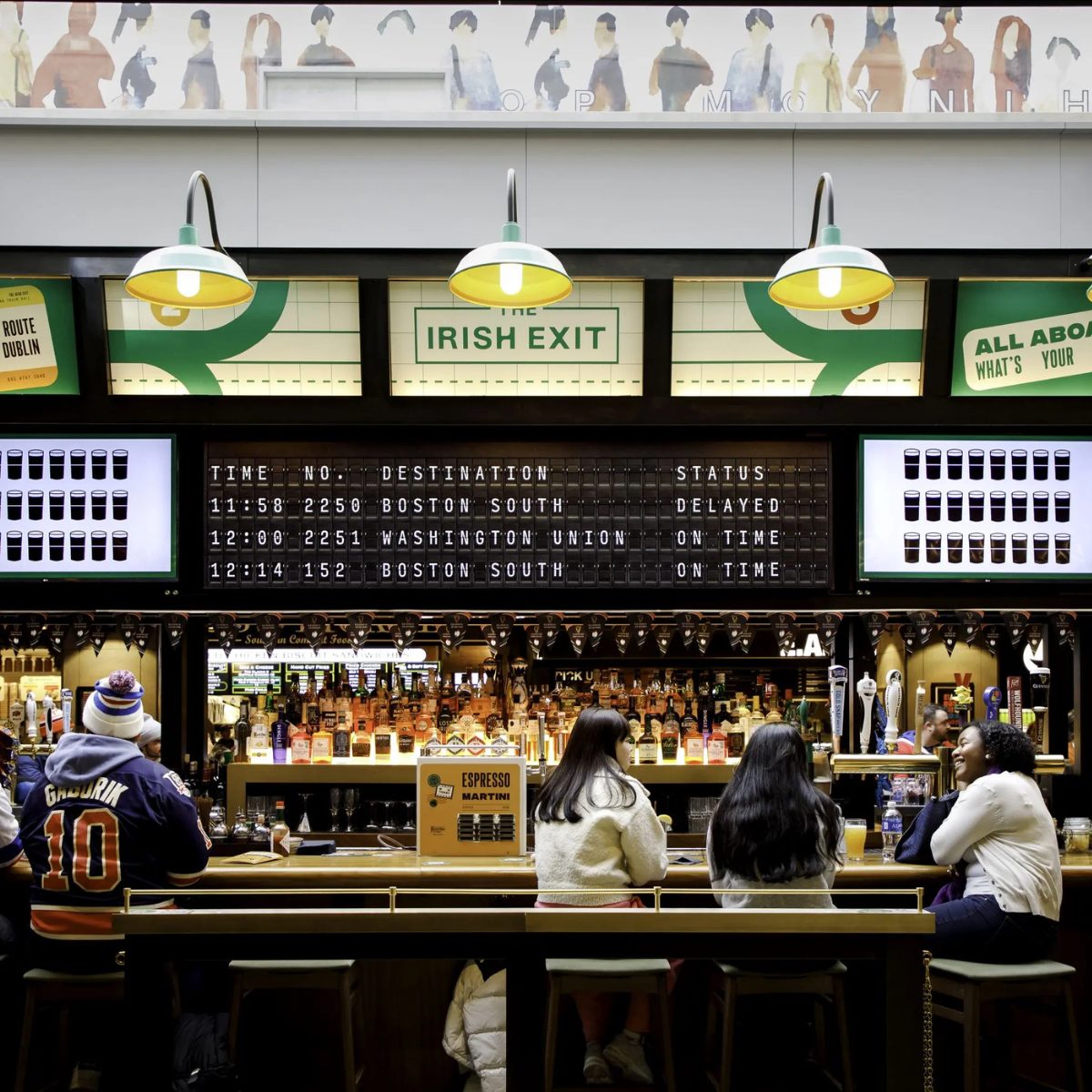
The Irish Exit at New York Moynihan Train Hall fits into a bustling, lively food court. The modernized “irish pub” is anchored with bespoke decor and a custom Split Flap bar menu.

Food Hall design doesn’t have to be dated or over-modernized. A balance of custom installations, lighting, crafted tile-work, along with an unobstructed flow, can set the tone for a chic, yet organic feeling space.
Here at Oat Foundry, we’re also seeing an increased demand for mechanical signage for food halls, with Split Flap projects for:
- Craft Food Halls in Cambridge ( they have additional locations around Boston)
- Marczyk Fine Foods at the Denver International Airport, a “food-hall-style” deli counter
- Reading Terminal Market in Center City Philadelphia
Providing an additional “third space” in communities, food halls are one of the most social and tactile places to eat today, with many offering in-person events and activities for residents and tourists alike.

Ladder Coffee Roasters is a part of Canopy Credit Union in Spokane, Washington. Architecture firm HDG and its partner, Propaganda Creative, created the unique, industrial-meets-artisanal credit union that prioritized community and comfort to foster a welcoming space.
📸 HDG Architecture

With sweeping ceiling beams and an open layout, CME Credit Union in Cranston, RI, looks more like a resort lobby than a place to open a checking account. The space was designed in partnership with NES Group.
📸 NES Group

Pioneer Federal Credit Union in Idaho, redesigned by design group Momentum, now features the brand’s signature blue and yellow, modern design fixtures, as well as carefully integrated technology, to create a community-forward space.
📸 Momentum
Banks and Credit Unions
A popular “third space” in 2026… is your local credit union? As strange as it may seem, credit unions have long since been synonymous with trusted community spaces, something highly sought after in modern society. Both banks and credit unions have pivoted accordingly, with some offering:
- In-house credit union cafes, such as the coffee shop within Park City Credit Union and Alden State Bank, in partnership with La Macchia Group, are following the trend set by Capital One Cafe
- La Macchia also brought a “community room” to Forward Financial Credit Union
- People First Federal Credit Union (Lehigh Valley, PA) partners with the Pennsylvania Parks & Forests Foundation on conservation fundraisers, while Redwood Credit Union also operates a 501(c)(3) foundation
In an effort to create a modern space, Commonwealth Bank in Sydney, Australia, invested in a new design language, wayfinding signage, and an organic material palette of light wood and neutral tile, as well as an Oat Foundry Split Flap in our Modern White finish.

Vibrant, dynamic imagery no longer needs to be synonymous with screens. In place of an oversized monitor, a mounted Picture Flap display can feature vital credit union features, as well as images of the local community. Community fixtures, including hospitals and universities, are already investing in these analog displays, as seen at the University of Arizona.
📸 Ayers Saint Gross

Commonwealth Bank in Sydney, along with its crafted wayfinding, features a modern white mechanical display that shows updates and brand messaging in place of a monitor or screen. The space was designed by Studio Ongarato and Hassell.
📸 SEGD

As seen with Pioneer Federal Credit Union, bold brand identity doesn’t need to be masked in “grey”llineal design. Rather, bright brand colors can be carefully integrated, as seen with the custom-color Cobalt Split Flap on display at Julith Coffee in Dubai.
📸 Julith Coffee
Adopting Analog: A Checklist for Brands
Adapting to analog in brand spaces is easier said than done. Requiring a careful balance between providing exceptional service (where the speed and convenience of digital often plays a huge part) and incorporating tactile elements that fit into not only the form, but functionality of a space, we find a few vital analog “checklist” items include:
- Is every screen in your space necessary to the buyer journey?
- What aspects of your brand space invite visitors to get comfortable and stay awhile?
- What forms of art, signage, and decor provide visual interest for visitors?
- What parts of your “digital” buyer journey have the most friction?
- How often do your customers have the ability to speak to an actual person?
- Does your brand have any tactile “artifacts” or brand ephemera to give a customer or visitor?
At the very minimum, answer this question: what first impression do visitors get from your brand space? A quick audit by customers, visitors, and employees can provide much-needed context and feedback on how people actually engage with and respond to your space.
To learn how your brand can implement an “analog” focal point in your lobby or office, book a complimentary consultation with our sales team via our analog signage page.