

With a decade of experience in the arts industry and a lifetime of experience crafting exciting stories in her D&D campaigns, Senior Sales Representative Colleen Wilson has a rich understanding of how strong creative vision leads to the most compelling narrative arcs. Picture Flap, an all-image version of Split Flap, presents intriguing opportunities for kinetic storytelling, unlike anything she’s seen, in museum galleries or the Forgotten Realms alike. With a Master’s Degree in Art History and experience as an Art Educator at the Barnes Foundation for a decade, Colleen calls Picture Flap “so much more than a billboard.”
“Its modular design and easy-to-use programming are built-in springboards to catapult your creative process,” says Colleen. Based on her experience working with brands including Starbucks, Royal Caribbean, Visit Austin, [solidcore], The Irish Exit, and Momofuku, as well as artists like Dara Vandor and John Peña on custom Oat Foundry installations, Colleen compares Picture Flap to modern analog art.
“Unlike traditional print media, Picture Flap allows you to pull on new levers to grab your audience – from ever-changing collages to the reveal of a new image orchestrated by a precisely timed animation,” she says.

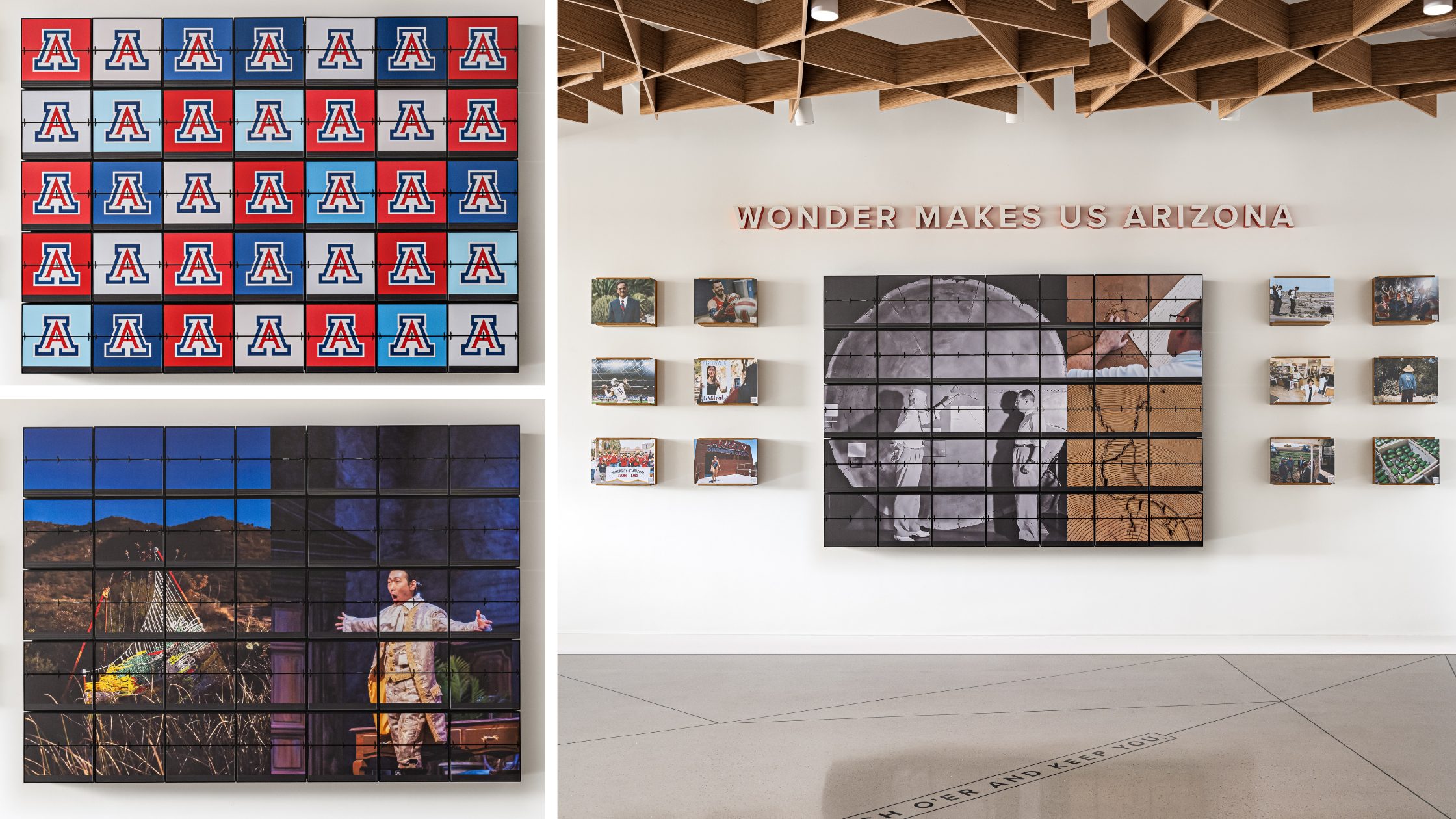
Pictured: Rotating school signage, scaled as a 5 row by 7 column display at The University of Arizona, is mounted as a focal point on a statement wall. (Images via Ayer Saint Gross)
A History of Art & Design Beyond the Canvas
In mid-century Europe, the kinetic art movement burst onto the scene, taking high art off the canvas with familiar names like Marcel Duchamp, Alexander Calder, and – most bizarre of all – Jean Tinguely contributing heavily. The movement took an interest in machines, exploring their newfound ubiquity in a freshly industrialized world. Rooted in turn-of-the-century Dadaism, early kinetic artwork skewed towards absurdity, rejecting the strict rules of oil painting in favor of novel engagement with spatial and temporal elements.
Around the same time, mechanized design elements began to appear in everyday life. Including the rise of Solari Split Flap displays in transit hubs across Europe and the world. As machines continued to proliferate throughout daily life, attitudes towards them became less abstract and more optimistic. The resulting aesthetic was mid-century modern, which celebrated the new opportunities modern technology afforded.
Picture Flap: A Modern Middle Ground
Picture Flap represents a strategic balance between the artistic and logistical proliferation of machines throughout the 20th century. In that way, each Picture Flap display is itself an example of storytelling in design. That sentiment is perfectly embodied by the display at the Joliet Museum just outside of Chicago, Illinois. The display features high-resolution photography that archives the rapid modernization of the atomic era. At the same time, the display is also an artifact whose lineage is rooted in that same historic moment. It is itself as much an object worthy of interpretation as the artworks it features.

Pictured: The Picture Flap created for the Blue Jays, standing at 5 rows by 17 columns, uses vivid, high-resolution sports imagery to create a one-of-a-kind mechanical statement wall.

Pictured: Rotating lobby signage, such as at Heritage Towers, is scaled to fit the space (example: a 5 row by 6 column display).
Telling Your Story with Picture Flap
Picture Flap is so much more than a billboard or a kinetic sculpture with historic roots. Each Picture Flap module holds 20 custom-printed flaps, so your team will dream up 20 Artboards in total, regardless of the size of the display. Large Hero-Images are a classic way to highlight your most beautiful product images, past projects, or evergreen branding.
High-quality art photography is particularly breathtaking on Picture Flap. And though Picture Flap displays are well-suited for audiences with refined taste, they are also appropriate and even enchanting for any audience, including the K-5th-grade students at Reedy Laurel Elementary School. Sometimes, the simple childlike intrigue that analog technology inspires can be just as powerful as a coordinated motion designed for artistic effect.

Pictured: The Picture Flap created for the Blue Jays, standing at 5 rows by 17 columns, uses vivid, high-resolution sports imagery to create a one-of-a-kind mechanical statement wall.

Pictured: Dynamic university signage, such as the University of Arizona, scaled as a 5 row by 7 column display, is placed directly into the architecture, creating a fully integrated installation.
Storytelling in Design: Using Picture Flap to Craft Your Narrative
Based in a rich artistic tradition, Picture Flap displays are an evolved storytelling tool suited to take on present-day design challenges. Collages, Quadrants, and One-Image-Per-Module artboards not only provide variety and visual interest but also offer the ability to mix and match sections from different artboards. With a Content Management System that allows you to quickly & easily create entirely new arrangements of images, Split Flap displays present near endless ways to tell your brand story to any audience. For example, you might keep a product image static on the left while that product’s color options continually flip on the right. Or pair your brand’s values with a collage of your staff embodying the company culture.
Finally, consider how animation style and timing will impact the viewing experience.

Pictured: A Ralph Lauren Picture Flap side by side with an LED screen of a similar size.
“A quickly-changing display with a whimsical animation would attract attention in a storefront such as Ralph Lauren,” says Colleen. “Alternatively, a slower pace with a simple, delayed animation may invite more reflection on the content of your imagery and capitalize on the delight of anticipation – ideal for art-forward designs.”
Ultimately, Picture Flap is a medium for your brand’s creative vision, and we can’t wait to build something truly unique with you.