

Here at Oat Foundry, when it comes to alternatives to our Split Flap displays, we’ve seen all the comparisons — from the aesthetics of our installations to Split Flap pricing. In our experience, many common misconceptions come up when people compare our mechanical Split Flaps to digital simulations. Here are the most common misunderstandings about how our displays function and what many miss about digital counterparts.

Mechanical by design, digitally controlled: Split Flap combines physical movement with modern content management.

Unlike a simulated flip board on a screen, every Split Flap message is created through real electromechanical movement.
Mechanical Split Flap Misconceptions
Ongoing Maintenance
Before leaving our shop, every display undergoes 50,000 rotations (equivalent to 10-15 years of simulated use). After installation, routine maintenance typically includes periodic dusting every 6-12 months. Because our systems are modular, teams can service or replace individual flaps or modules without treating the display as a single unit.
Tech Support
Our displays require little to no maintenance, but if needed, we offer real-time error correction with a support team of real people (not AI or chatbots).
Making Updates
Despite having a physical “face”, the backend of Oat Foundry Split Flap and Picture Flap displays is digitally controlled. Like simulated digital Split Flaps, authorized users can create, schedule, and update messages through Oat Foundry’s browser-based Portal CMS; installations can also connect through APIs to project-specific data sources and workflows.
Updates Across Locations
Networked installations can be managed through a central content-management workflow, allowing users to instantly publish scheduled or time-sensitive updates to one or more displays across several locations.
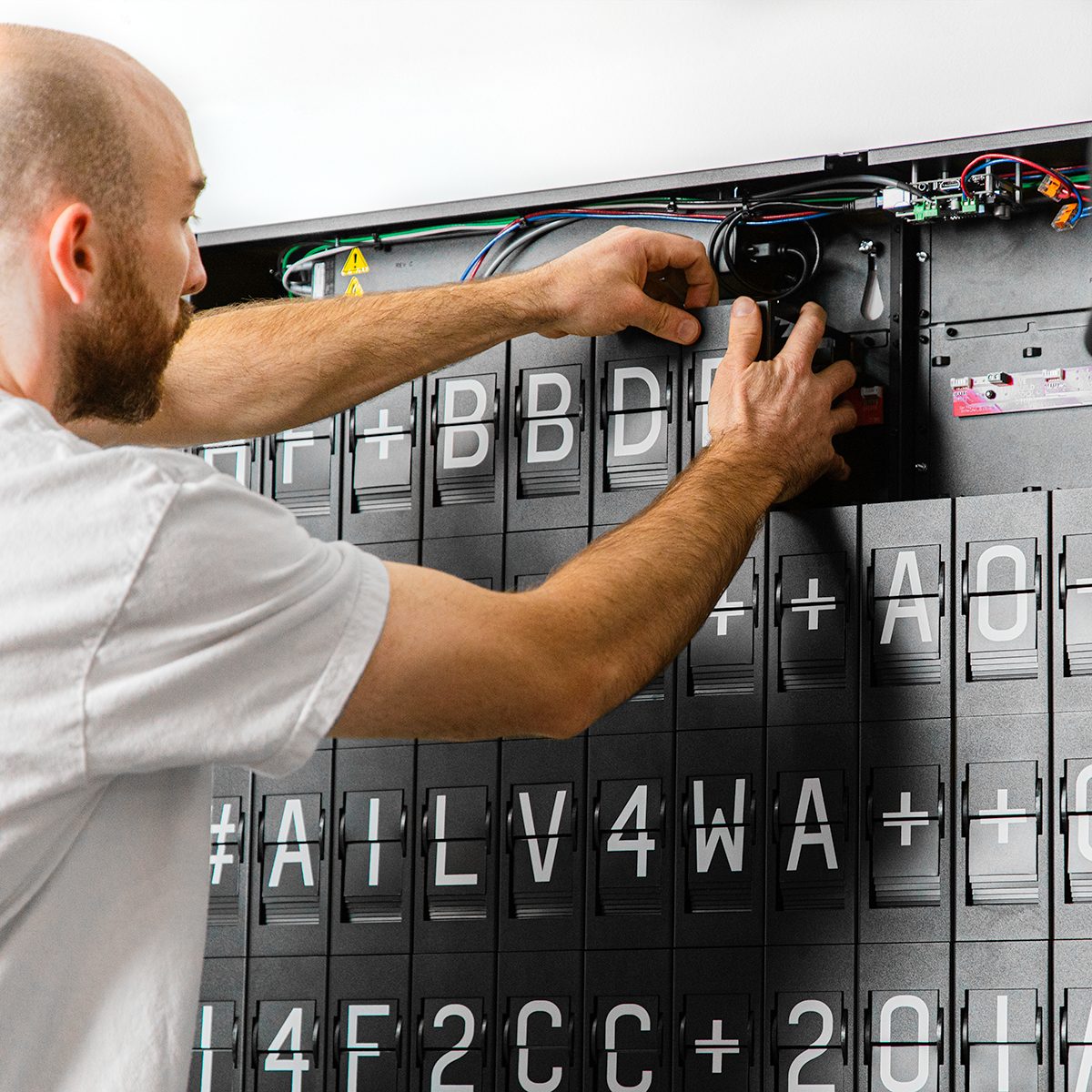
Built module by module, mechanical Split Flap displays can be serviced without treating the entire installation as a single unit.

The Irish Exit features a mechanical Split Flap in place of digital signage, using kinetic energy to rotate through brand messaging, train times, and menu items.
Digital Split Flap Misconceptions
Always On
While a digital simulation can always be “on”, the functionality depends on a chain of electronic and software components: the display panel, power supply, media player, network connection, CMS, account credentials, content files, schedules, and sometimes cloud services. A break in any part of that chain can lead to stale content, failed updates, blank screens, frozen playback, incorrect input selection, flicker, or offline status.
Always Should Be On
Just because digital screens can always be on doesn’t mean they should be. Electronic displays consume energy while operating, and their energy use varies substantially by display technology, brightness, size, content, operating schedule, and connected equipment. The European Commission treats electronic displays, including TVs, monitors, and signage displays, as products requiring energy-efficiency labeling and regulation.
Physical Failures
Monitors, screens, and video walls are prone to cracks, broken pixels, and overheating. Cables can break, and outages can occur. Over time, these failures may become more frequent as displays age and fall out of date. There’s even a word for all of this – “disposable digital”.
Ongoing Maintenance
Anyone with a computer or monitor knows it routinely needs maintenance. Our phones even require updates. Digital-signage maintenance guidance specifically identifies network connectivity, cabling, media-player status, CMS configuration, power, and content synchronization as recurring operational concerns (not to mention the smudges and fingerprints that need cleaning off screens).
Mechanical vs. Digital Split Flaps: Misconceptions Takeaway
Neither physical nor digital displays are beyond maintenance or downtime. The key question isn’t whether a display has moving parts, but how it is engineered, installed, monitored, serviced, and supported over time. At Oat Foundry, displays are hand-built electromechanical systems and require the same care as any public-facing installation. Visit our Portal page (our web-based content management app) to learn how our modern Split Flap displays pair analog motion with software, scheduling, and API integrations.

Let’s Put Your Wall in Motion
Split Flap transforms ordinary spaces into unforgettable experiences.
Book a demo today to learn how to build a display as unique as your brand.