

As people approach the finish line, their perspective shifts.
Effort becomes more focused, and what once seemed distant now feels attainable.
Behavioral research describes this as the goal gradient effect: people naturally increase their effort as they see themselves getting closer to a goal. Studies show that participants work harder and move faster when they believe completion is near, even if the task itself has not changed. The difference is in perception, not workload.
In the workplace, perception shapes motivation.
When progress is visible, motivation becomes tangible. When motivation becomes real, people move differently.
For sales teams in fast-paced, target-driven environments, this principle is practical. The key consideration is whether the workspace is designed to support the goal gradient effect.
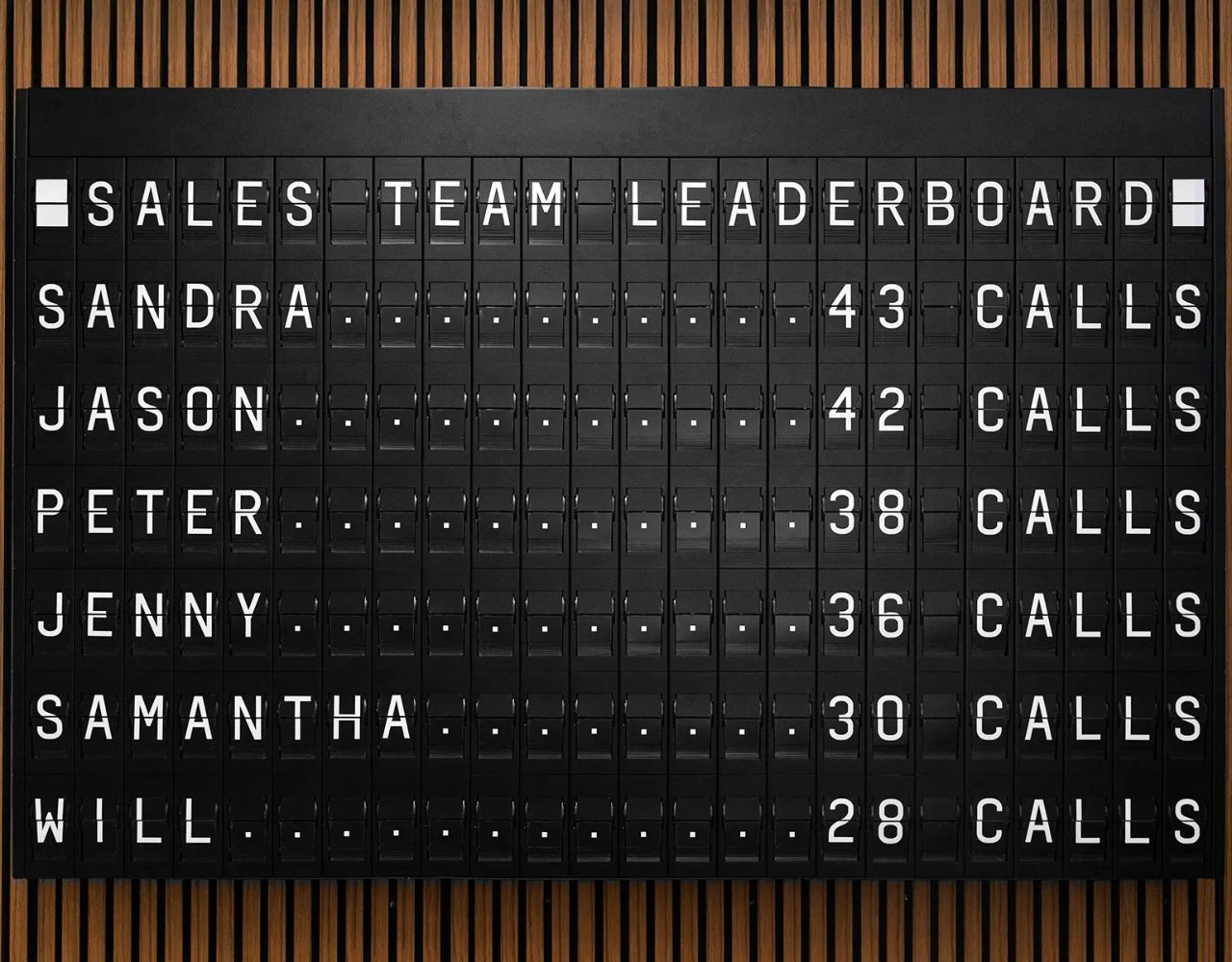
The Split Flap at Oat Foundry rotates through sales leaderboard updates.
What is the goal gradient effect, and how does it improve sales performance?
There is a profound, deep-rooted reason why split-flap displays instantly resonate.
The goal gradient effect is a psychological principle where individuals increase their effort as they perceive themselves getting closer to a goal. In sales environments, this means that when progress is clearly visible, through tools like leaderboards, teams are more motivated to close deals, improve rankings, and reach targets faster. Physical, real-time displays like Split Flap boards enhance this effect by making progress highly visible, engaging, and continuously present within the workspace.
If visibility drives motivation, the next step is to consider how to make progress unmistakable.
The challenge is to design progress so it cannot be overlooked.
For many teams, another dashboard or report is not the answer.
A physical, shared solution is often more effective.
It should be present in the spaces where decisions are made and momentum develops.

An Oat Foundry Split Flap in Classic Black casing displays sports scores.

A mounted Split Flap welcomes guests to the Pebble Beach Visitor’s Center.
Understanding the Goal Gradient Effect in Real-World Environments
The goal gradient effect is driven by proximity, not pressure.
When people see how close they are to a goal, such as a sales quota, ranking, or milestone, their sense of urgency increases. The goal becomes immediate rather than abstract.
In sales environments, this shows up in familiar ways:
- A rep pushing harder at the end of the quarter
- A team rallying to hit a shared number
- A competitive surge when rankings tighten
But here, this effect relies on visibility. If progress is hidden, buried in software or internal systems, tucked into a report, or only reviewed during meetings, the psychological trigger weakens. The goal remains distant, even if it’s not.
To activate the goal gradient effect consistently, progress needs to be clear, continuous, and shared by the entire team. This is where the environment becomes important.
Why Traditional Sales Dashboards Fall Short
Most sales teams already track performance. The challenge is not a lack of data, but a lack of presence. Traditional dashboards, whether on laptops, internal platforms, or wall-mounted screens, often fade into the background. They require deliberate effort to access and compete with other tasks and priorities. And over time, they are seen occasionally, but not truly felt.
Motivation builds from constant awareness, not occasional visibility. If progress is not integrated into the environment, it is easily overlooked. When progress is overlooked, it cannot influence behavior in real time.

Pass & Stow at Citizens Bank Park uses a Split Flap display for its drink menu, which also keeps up with the Phillies’ score.
Bringing the Goal Gradient Effect Into the Physical Space
Choosing the right type of signage is only half the equation. There is a difference between seeing information and experiencing it. A Split Flap display bridges this gap. Originally designed for transportation hubs where timing and attention are critical, Split Flap boards bring information to life through motion and sound. Each update is not just displayed; it is revealed in real time. It unfolds.
In a sales environment, that matters. Every shift in ranking, every deal closed, and every incremental step toward a goal becomes visible in a way that is difficult to miss. It’s not a static screen. It becomes a dynamic system that reflects progress. Bringing excitement and anticipation. When progress is part of the physical space, it naturally becomes part of the team’s awareness without requiring extra attention.
How Split Flap Leaderboards Turn Visibility Into Motivation
A Split Flap leaderboard is effective not only for its aesthetics, but because it aligns with how people respond to visible progress.
They Make Progress Visible
At any given moment, the team can see exactly where they stand. Not by logging in. Not by checking a report. Just by looking up. Constant visibility reinforces proximity to goals and helps sustain momentum throughout the day.
They Create Shared Momentum
Sales can be individual, but motivation is often collective. When a leaderboard updates in real time, everyone sees it together. Wins are shared, and progress is collectively experienced. This approach turns individual progress into a shared experience.
They Reinforce Micro-Wins
Motivation doesn’t come from the finish line alone. It builds through small, consistent signals of progress. Each flip of a panel or change in ranking is a reminder that progress is happening and effort is producing results. These small reinforcements accumulate over time.
They Turn Data Into Experience
Numbers on a screen are easy to overlook. Movement, sound, and physical presence create a different kind of engagement. People tend to remember these experiences.
Designing a Sales Leaderboard That Actually Motivates
Not all leaderboards are created equal. To support the goal gradient effect, the design should be intentional. Start with what matters most:
- Individual rankings to encourage accountability
- Team totals to reinforce shared goals
- Progress toward quotas to highlight proximity
Then consider frequency.Real-time or near real-time updates are most effective. The shorter the gap between action and visibility, the greater the psychological impact.
Placement matters, too. The most effective leaderboards are positioned where people naturally gather:
- Sales floors
- Entry points
- Common workspaces
These are places where visibility is natural and unavoidable. The goal is not to demand attention. It is to earn attention consistently.


Our Classic Black Split Flap can be used in offices for shout-outs, employee milestones, brand messages, and much more.
The Role of Movement, Anticipation, and Energy
When a Split Flap display updates, a subtle shift occurs in the environment. For a brief moment, attention shifts within the space. The sound of panels flipping and the visible change in information naturally draw attention. At that moment, people notice the update. They check their position. They notice changes. They recalibrate. It is a small but meaningful interruption. Because it reconnects people to progress. Over the course of a day, these moments create a sense of rhythm. They reinforce the sense that progress is happening, effort is accumulating, and the goal is approaching.

In addition to sales leaderboards, our modern Split Flaps (legible from 100 ft away) are often used in bars and restaurants as dynamic interactive menus.

A Split Flap in our Modern White finish hangs in Titleist, a pro golf shop that is located at Pinehurst Resort in North Carolina.
Beyond Competition: Building a Positive Sales Culture
Leaderboards are often associated with competition. At their best, leaderboards offer more than competition. They create transparency. When progress is visible to everyone, it fosters:
-
- Alignment around shared goals
- Recognition of effort, not just outcomes
- A sense of collective movement
This approach shifts the focus from individual wins to shared progress. This shift is important for building a positive culture. Because sustainable performance doesn’t come from pressure alone. It comes from clarity, momentum, and a sense that everyone is moving forward together.
Where Split Flap Leaderboards Make the Biggest Impact
While the application is broad, certain environments benefit most:
- High-performing sales teams
- Real estate brokerages
- Tech and SaaS organizations
- Financial and enterprise sales environments
Anywhere progress is tracked, and performance is tied to visibility. Because in these environments, even small increases in motivation can lead to meaningful improvements in results.

Every Split Flap is built to order, matching your specific space and intended use.
Where Visibility Turns Into Performance
The goal gradient effect is straightforward in theory. People move faster when they believe they’re getting close. In practice, this belief depends on what people can see. If progress is hidden, motivation fades. If progress is visible, motivation escalates.
A Split Flap leaderboard doesn’t change the goal. It changes how people experience the goal. It brings the goal into the daily environment and into the moments where decisions are made and effort is applied. Sometimes, this visibility makes the difference. Not a new strategy. Not a new system.
It is simply a clearer view of progress and proximity to the goal. When people can see the finish line, they maintain their momentum. They move toward it.

A Split Flap sales leaderboard or message board can be mounted directly to the wall, easily integrating into any modern workspace.