

When you walk into a room with a mechanical flap display, the first thing you notice is the flip itself. That causes you to stay a beat longer than you meant to, waiting for the next rotation – and if the display is doing its job well, you walk out with an image, a feeling, or a story you didn’t have when you walked in.
That’s the experience behind Oat Foundry’s Picture Flap, the all-image flap display that combines the mechanics of a classic text-based departure board with a curated sequence of full visual panels. The result, which is closer to a kinetic mural than to a sign, is what we call a wall flipbook.
What Is a Custom Flap Display?
Picture Flap (otherwise known as a custom flap display) is a multi-image version of our Split Flap system. Where a standard Split Flap cycles through letters and numbers, a Picture Flap cycles through full visual panels using the same mechanical flip technology that’s been a public-display standard since the mid-20th century.
Each image is made up of individual mechanical flap modules, giving the surface its signature texture and depth. From up close, you can see every flap. From across the room, they come together into a cohesive, layered image, with a surface that never looks quite the same from one moment to the next.
Every Picture Flap, whether rectangular, square, vertical, or L-shaped, is custom-built to order. The exact configuration follows the architecture and the story being told.

Custom Picture Flap installations scale brand imagery, artwork, logos, symbols, and messaging to create a mesmerizing visual story.
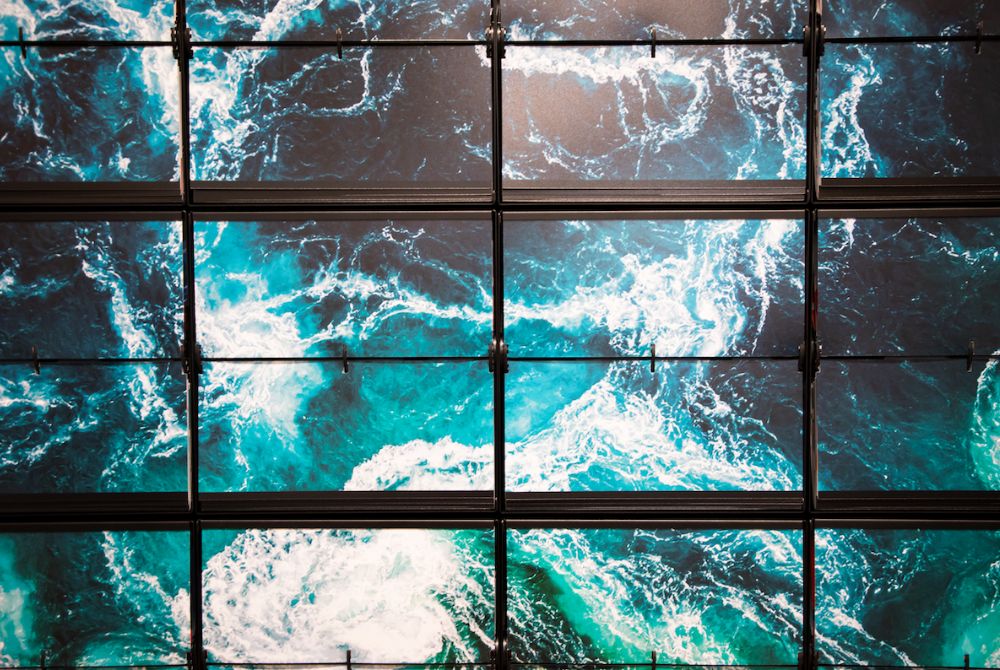
Brand photos and art become kinetic content on Picture Flap, with mechanical modules creating movement as one image transitions into the next.

From photography to branded graphics, each Picture Flap frame can become another chapter in a larger visual story.
The Wall Flipbook Concept
A flipbook works because images in sequence become something more than any single frame, and the momentum between them as they flip carries the story forward. A Picture Flap display operates on the same principle, but at a wall-sized scale.
For brands, it creates an image-based storytelling medium that doesn’t really exist anywhere else. A few ways clients are currently putting it to use:
- Hospitality brands rotating through seasonal property photography
- Universities cycling through archival images of campus milestones
- Flagship retail spaces showcasing product imagery that changes with the collection
- Leasing offices displaying neighborhood scenes, lifestyle photography, and community moments
Heritage Towers, a residential community in Texas, was among the first to use this concept in a leasing context. Their Picture Flap installation uses a Texas-branded image sequence to welcome visitors as soon as they walk through the door. Unlike digital screens or printed wall graphics, the flap display not only shows off the images but also creates a mood.

Safe Catch used a Picture Flap to turn product photography into a rotating brand story, giving multiple products a moment on the wall.
Building Brand Chapters
The Picture Flap installations that work best aren’t just collections of great-looking photos. They’re built around a deliberate sequence with a beginning, a middle, and an arc.
The guiding principle is that each image should carry its own weight, and the sequence should carry the larger story. That’s what makes a wall flipbook different from a slideshow.
Think in brand chapters. What are the 8 to 12 anchor images that tell your brand’s story in sequence, each one building on the last?
For a food hall, that might move from building history to individual vendors to the community they serve. For a corporate headquarters, from the founding story to the product to the people. For a cultural institution, from the permanent collection to a featured show to the broader mission.
See our guide to visual identity design in office spaces for more on how this translates in practice.
Where a Flap Display Works Best
A Picture Flap display is built for high-visibility environments with longer sightlines; spaces where a hero wall needs to do real work from the moment someone walks in.
Great examples are lobbies, reception areas, flagship retail floors, museum galleries, leasing offices, and hospitality spaces. Particularly in leasing, retail, and hospitality contexts, the entry display sets the tone before a single conversation begins.
For experiential marketers, flap displays generate social media moments without prompting. Their movement, sound, and visual distinctiveness lead to exactly the kind of organic storytelling among the public that content calendars are created to inspire.
For more on creating signature visual focal points in branded spaces, see our guide to brand accent wall ideas.

Picture Flap can bring changing color, graphics, and movement to large-scale branded environments where a static mural would tell only one story.

The University of Arizona’s custom flap display rotates through athletics imagery, logos and university storytelling.
Getting Started with Picture Flap
Each Picture Flap is built to order, starting with a conversation about your space, your brand, and the story you need to tell. From there, our Philadelphia team handles the final design work, fabrication, and installation.
Start by thinking like an editor. What are the images that define you right now? What story do they tell when placed in sequence?
Those two questions tend to lead directly to the strongest installation. Most clients design their image sequence to be evergreen content – art that holds up across seasons and pairs with the brand’s identity indefinitely.
Every flap display we build ships with Portal, our content management system, at no additional cost (and no subscriptions, ever!). Portal covers scheduling, an image library, 32 transition styles, and multi-user access, so keeping the image sequence current is manageable whether you’re running one location or 20.
Want to see how it comes together in real spaces? Explore our Picture Flap projects and check out this full comparison of display formats.
